
Growing Beef Newsletter
August 2026, Volume 17, Issue 2
Short stature corn as an alternative for corn silage
Shelby Gruss, ISU Extension forage specialist, and grad student Courtney Harle
Derechos, hail, drought, and mounting disease pressure have all exposed weak points in conventional tall corn silage systems. Short stature corn (SSC), hybrids bred to stand roughly a third shorter than conventional corn while carrying the same leaf number, has been promoted as a more stable option. The obvious question for silage producers is whether that shorter plant still puts enough tonnage in the pile, and whether the feed is any good.
We evaluated that question at the ISU Agricultural Engineering and Agronomy Research Farm near Boone in 2024 and 2025. Three SSC hybrids (103-, 105-, and 106-day) were compared with three tall hybrids, a dual-purpose, a silage-specific, and a brown midrib (BMR), at two planting populations, 34,000 and 40,000 seeds per acre, in a randomized complete block design with four replications. We measured plant height, canopy light interception, forage mass, harvest moisture, biomass partitioning, and nutritive value.
Yield held. Forage dry matter mass did not differ among hybrids or populations in either year, averaging 8.2 tons DM per acre in 2024 and 7.4 tons in 2025. There was no yield penalty for going short.
Height difference was real but modest. SSC hybrids were about 21 inches shorter at tasseling in 2024 and 19 inches shorter in 2025, roughly a 20 percent reduction, less than the 30 to 40 percent often cited for these hybrids. Even so, that gap should improve late-season field access for sidedress nitrogen or ground-applied fungicide, and should help with standability.
Canopy closure was unaffected. Light interception followed the same curve across all hybrids and populations, reaching about 94 percent by the V15 stage. Shorter plants did not thin the canopy, which suggests weed suppression and weed management should look much like a conventional silage system.
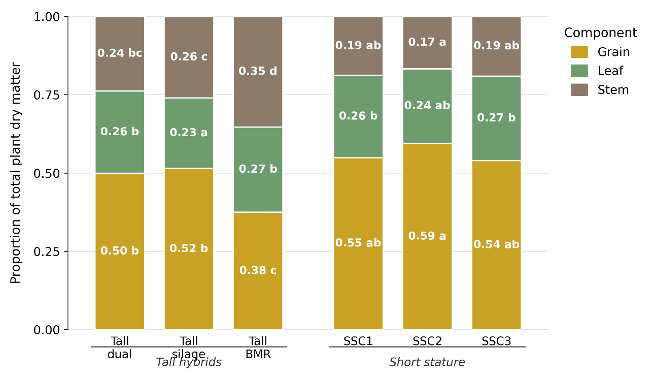
The plant was built differently. SSC hybrids put more of their biomass into grain and less into stem than tall hybrids, and carried a leaf-to-stem ratio 0.47 units higher (Figure 1). That structural shift showed up directly in the feed analysis.
Quality improved. Averaged across hybrid groups and consistent in both years, SSC ran 6 percentage units lower in ADF, 8 to 9 units lower in NDF, and 8 units higher in starch than tall hybrids. Lignin was comparable to the BMR hybrid, notable, since BMR is bred specifically for that trait, and 30-hour in vitro digestibility was about 3.5 points higher than tall hybrids and on par with BMR.
Caveats. Hybrid-specific variability was substantial; not every SSC hybrid performed equally on every metric. Southern rust pressure and wet conditions in 2025 pulled absolute values down, though the relative ranking of SSC versus tall held steady across both seasons. We did not feed this silage, so animal performance remains inferred from published work rather than measured here.
This monthly newsletter is free and provides timely information on topics that matter most to Iowa beef producers. You’re welcome to use information and articles from the newsletter - simply credit Iowa Beef Center.



