
Growing Beef Newsletter
February 2026, Volume 16, Issue 8
Calfhood castration
Beth Reynolds, IBC Program Specialist, and Erika Woolfolk, ISU Extension beef specialist
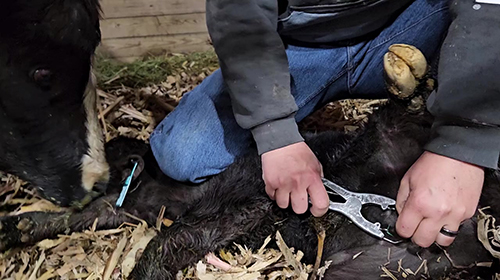 When it comes to castrating bull calves that are not bound to be herd sires, the general recommendation is “the earlier, the better.” If feasible within the management system, castration via surgical or banding within the first week of life is often recommended, although most research data has only evaluated banding prior to 3 months compared to near weaning. Since spring calving is here for some, and rapidly approaching for others, it’s a good time to review calfhood castration considerations.
For calves under 3 months, elastic band castration may be the preference because it is bloodless, simple to perform, well-tolerated, and effective. For older, larger calves, specialized large-animal banders, such as the Callicrate Bander, can be employed with similar results. However, there is still pain associated with banding, and although it causes less immediate, acute pain, there is a longer duration of chronic pain. The testes and scrotum typically fall off in 2-4 weeks. Surgical castration, often with a newberry knife or emasculator, may be a preferred method because of immediate testicular removal and less chronic pain. Ideal surgical techniques minimize bleeding through clamping, stretching, or crushing blood vessels but also allow some drainage in the initial healing process.
Producers might also consider reviewing pain mitigation options. Recent years have seen progress in the number of products available, their effectiveness, and the costs. While a larger emphasis is often put on providing pain mitigation to calves >6 months of age when castrated, pain mitigation at all ages has shown benefits to managing calf stress. Local anesthesia is one option to provide comfort for up to 2 hours but it takes a few minutes to be fully effective. Nonsteroidal anti-inflammatory drugs such as meloxicam or transdermal banamine can reduce inflammation and offer relief up to 48-72 hours, but this is an extra-label use of these drugs and veterinary oversight is needed. Newer technology with lidocaine infused castration bands labeled for calves under 250 lbs are gaining popularity for ability to offer pain relief as quick as 2 hours and lasting up to 42 days.
Infection risk is another important consideration, particularly for tetanus. Tetanus, an anaerobic bacteria found in soil across the U.S., is a more common infection concern when castrating. Once a wound scabs over and seals on the outside, the bacteria produces a toxin that will cause severe health issues. There are two preventative options: a tetanus vaccine or an antitoxin. Producers should select the best method based on their overall risk, product availability and when the product will be administered compared to when the wound will be the most susceptible. A clean, dry environment and clean tools are important in preventing any infection, including tetanus, and producers should all talk to their herd veterinarian to make the most effective plan for their operation. In the right conditions, a newborn calf that is banded may be low enough risk where the veterinarian does not advise an injectable precaution.
“The earlier, the better” recommendation is backed with years of data using cortisol to measure acute stress and performance measures like weight gain and even morbidity challenges in the feedyard to assess longer-term, chronic stress. Some may argue that leaving bull calves intact will boost performance because of testosterone, but remember puberty is not expected until about 10 months of age. Rather, research shows that steer calves implanted at branding time will outperform counterparts castrated at ~6-8 months. Obviously, producers developing herd sires will approach the decision and timing of castration differently than commercial producers.
Particularly for those castrating for the first time, or earlier than they have before this season, there will be individual instances where it’s best to leave the calf intact and evaluate later. Equip yourself with the knowledge on proper techniques, so that you can confidently and effectively manage bull calves.
This monthly newsletter is free and provides timely information on topics that matter most to Iowa beef producers. You’re welcome to use information and articles from the newsletter - simply credit Iowa Beef Center.



