
Growing Beef Newsletter
February 2026, Volume 16, Issue 8
Selecting free-choice supplementation for grazing cattle and achieving desired intakes
Aimee Lutz, IBC Director and Beth Reynolds, IBC Program Specialist
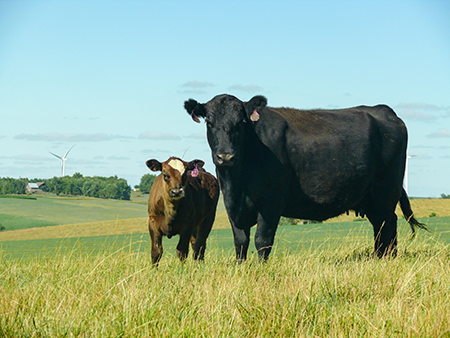 For cattle on pasture, free-choice supplementation using tubs, blocks or loose mineral provides a convenient means of delivering nutrients that complement existing forages. Selecting the best matched supplement and managing it to achieve the desired intake is key to seeing the benefits of supplementation. Free-choice supplements are formulated to target specific nutritional requirements, but only when the specified intake range is achieved.
For instance, a 20% protein tub with vitamins and minerals consumed at 1.25 lb/hd/d supplies 0.25 lb additional protein to the animal. For a cow consuming 25 lb total DM feed, this will raise the protein of the total diet by 1%. However, if less than 1.25 lb/hd/d supplement intake occurs, protein as well as vitamin and mineral intake may be insufficient for the animal depending on the nutritional goal. It is important to recognize there is a lot of variation around labeled intake range of free-choice supplements, and it may be necessary to select a supplement with a different nutrient composition or manage placement to achieve the desired intake if cattle are consistently not consuming within the labeled range.
Below are some considerations for selecting and managing free-choice supplements.
Production Goals
Before selecting a supplement, consider the type of cattle being grazed and stage of production or intended growth rate for that animal as this will determine nutrient requirements. Additionally, the nutrient profile of a pasture changes as growing season progresses. These factors go into determining which supplement is most appropriate for the situation and whether different supplements are needed throughout a grazing season.
Tag Nutrients
It is important to pay attention to the tag. Depending on the supplement, it may provide only vitamins and minerals, only protein, or vitamins, minerals, and protein. The tag is required to provide the user with which nutrients are supplied and how much is there. The tag also will list sources of ingredients which should be listed in order of highest to lowest inclusion. Protein supplements may include only natural protein sources such as corn distillers grains or soybean meal, but some also may include non-protein nitrogen (NPN) sources such as urea or slow-release nitrogen products. Grazing cattle can utilize some NPN to grow rumen microbes and improve forage fermentation, but it is important to prevent over consumption which poses a risk of ammonia toxicity. Additionally, minerals may be supplied from inorganic sources (oxides and sulfates) or organic sources (amino acid complexes, proteinates, glycinates, or oligosaccharides).
Tag Feeding Directions
The tag also should provide recommended feeding practices and an expected intake range. Free-choice loose mineral intake is often achieved with salt level and(or) inclusion of carriers such as processed grain product. Salt can be an attractant as well as a limiter. Loose mineral is often formulated with a salt content that entices intake but prevents over consumption. For blocks and tubs, degree of hardness also will impact intake. While manufacturing can be used to target intake range, there is a bit of an art to free-choice feeding that is specific to each in-field operation. Supplement intake will fluctuate throughout a grazing season depending on condition of the pasture, weather and cattle behavior. However, if consistent over or under consumption is occurring, positioning tubs, blocks, or mineral feeders in areas that are frequented by cattle (watering or loafing areas) can increase intake, whereas moving them to less frequently visited places can be used to control over consumption. Placing a sufficient number of loose mineral feeders, blocks, or tubs for the number of cattle in the pasture will ensure mineral access to all cattle. Placing too much loose mineral for the number of cattle can result in unconsumed mineral that can accumulate moisture, crust over, and eventually spoil. For tubs, having enough cattle consistently feeding keeps the surface condition of that tub such that desired intake is achieved. Also, be aware that intake rate of the same supplement may differ between young stockers and mature cows.
Supplement Maintenance
While free-choice supplements are low maintenance to feed, they do require consistent attention. Regardless of the type of free-choice supplementation, consumption needs to be monitored frequently to ensure targeted intake is being achieved. Free-choice supplements are subject to weather elements. Given the salt content of loose mineral, moisture can accumulate and nutrient leaching or crusting can occur. Loose mineral is also subject to wind loss. Using a weatherized mineral and covered mineral feeders help minimize these losses. For tubs, excessive rainfall can cause the top surface of some tubs to soften. In most cases, cattle readily eat the surface, but if that water sits too long, the softened material can spoil and cattle will not consume. Dumping excess surface water and scraping any spoiled surface material after significant rainfall allows the remainder of the tub to be useful. Additionally, as tubs are consumed, they become lighter and can be over turned by cattle or wind preventing consumption. Regular attention to make sure tubs are properly positioned and in good surface condition is important to achieve desired intake.
Summary
Free-choice supplementation can be a powerful option for meeting the nutrient needs of grazing cattle where daily feed delivery is a challange. Selecting a supplement that meets the nutritional goals of the operation and then managing feeding of that supplement to achieve the targeted intake range is key to meeting the nutrient requirements of grazing cattle and fully utilizing pastures.
This monthly newsletter is free and provides timely information on topics that matter most to Iowa beef producers. You’re welcome to use information and articles from the newsletter - simply credit Iowa Beef Center.



