
Growing Beef Newsletter
February 2026, Volume 16, Issue 8
Using a simple behavioral rope test to monitor impairment status and welfare in feedyard cattle
Dr. Emiline Sundman, postdoctoral research associate, Iowa State University
Impaired (i.e., ill, injured, poor-doing) feedyard cattle are often housed in hospital or chronic pens for specialized monitoring and care. Impaired animals typically display decreased activity and exploration behaviors1, and measuring these behavior changes could help ask cattle, “How sick do you feel?” Such information would be helpful for timely treatment and euthanasia decisions that impact cattle welfare. In neonatal dairy heifers, calves with bovine respiratory disease (BRD) or a fever were less likely to approach a novel object than healthy calves2. A novel object test of impairment has not been applied to feedyard cattle. Therefore, the goal of this study was to explore if impaired feedyard cattle would interact with a novel cotton rope hung in their pen, and if so, if individual impaired cattle rope interactions would be associated with impairment diagnosis and severity.
Methods
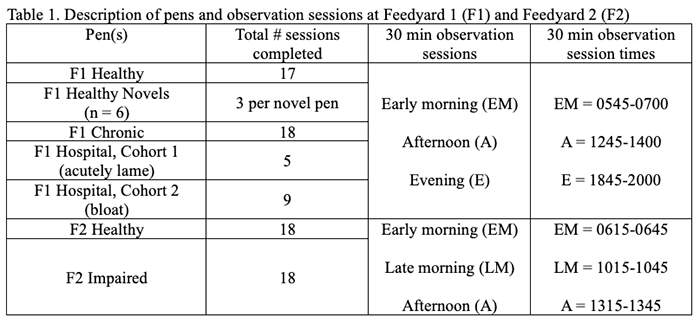
Pens of healthy and impaired cattle from two Iowa feedyards were enrolled in this study. Feedyard 1 (F1), enrolled in July 2022, was a 5,200-head operation that fed ranch-derived yearling beef steers. Seven pens of healthy cattle and three pens of impaired cattle were enrolled. The healthy pens were either open dirt lots or 3-sided barns with bedded concrete flooring and held between 65-170 healthy steers. One healthy pen was observed on all six days, and seven were novel pens that were only observed on one day. The impaired cattle pens were: one chronic pen in an earthen-floored covered barn with eight chronically lame steers, and one hospital pen in an earthen-floored covered barn that held two separate cohorts over the study period. The first cohort included two acutely lame steers, and the second cohort included two steers recovering from bloat. Feedyard 2 (F2), enrolled in July 2023, was a 3,000-head operation that fed auction-derived weaned beef heifers. One pen of healthy cattle and one pen of impaired cattle were enrolled from this feedyard, and both were observed on all six days. The healthy pen was a 2-sided barn with bedded concrete flooring that held 150 heifers, and the impaired pen was a combined hospital/chronic pen in an open earthen-floored lot, containing 21 cattle with acute or chronic BRD and 3 chronically lame cattle.
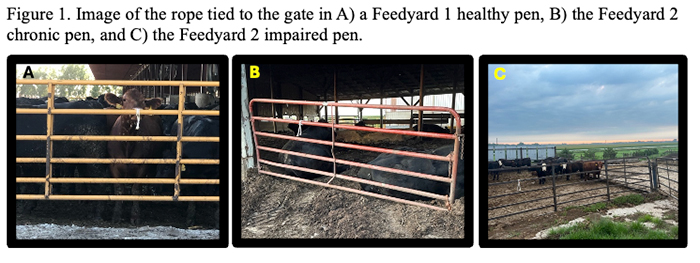
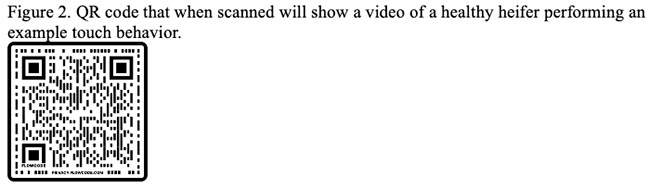
The novel rope test was conducted three times a day (TOD) on six non-consecutive days, for a maximum of 18 total sessions. At F1, the three TOD were early morning, afternoon, and evening. At F2 TOD were early morning, late morning, and afternoon. Each test lasted 30-min (Table 1). At the beginning of each test, one observer slowly approached the pen, tied a 32-inch length of 3/8-inch diameter cotton rope to the railing of a gate in the pen, and zip-tied the rope to the gate for extra security (see Figures 1A, 1B, and 1C). The observer then moved back approximately 10-feet and began recording cattle interactions with the rope. All instances of two behaviors, reach and touch, were recorded. Reach was recorded when an individual moved their head within one-head length of the rope without making contact. Touch was recorded when an individual contacted the rope with their muzzle and/or tongue (Figure 2). Both reach and touch behaviors ended when the animal looked away from the rope. Ear tags or unique markings were used to identify and record individual impaired cattle that interacted with the rope. Temperature-humidity index (THI) calculations were performed for each observation session.
The reach and touch behaviors were combined into rope-directed interactions (RDIs). A statistical program (SAS) was used to determine if there was a statistical difference between RDIs in the healthy versus impaired cattle pens, and if TOD impacted pen-level RDIs. Microsoft Excel was used to describe the numeric differences between individual impaired cattle RDIs.
Results and discussion
Pens of impaired cattle performed statistically fewer RDIs than pens of healthy cattle when first presented with the novel rope (p = 0. 0012). On average, impaired pens only performed 0.75 RDIs in the first session, while healthy pens performed 66. In the remaining sessions when the rope was no longer completely novel, this pattern persisted. The median RDIs in the impaired pens were either 0 or 1, although the most active sessions in each pen had 22, 32, and 7 RDIs. In the healthy pens the median RDIs ranged from 34 to 63.5 RDIs, with the most active sessions having 75, 100, and 126 RDIs. Since decreased activity and exploratory behavior were expected in impaired animals1,2, this result confirmed our hypothesis, and this is the first time these behaviors have been confirmed in feedyard cattle.
Pen-level RDIs were also impacted by TOD (p < 0.0036). Sessions completed in the early morning and evening had the highest RDI levels, while afternoon and late morning sessions had the lowest. Cattle are expected to have higher activity around sunrise and sunset3,4, which matches the high activity periods in this study. This study took place in the summer when THI is relatively high, and so it was not possible to completely determine whether TOD, THI, or both were responsible for these effects. One previous study of healthy feedyard cattle rope interactions found that cold temperatures did not inhibit rope use5, but it is unclear if this would hold true for impaired cattle populations.
While RDIs were low in impaired pens overall, some individuals did perform this behavior. Individual impaired cattle RDIs can be found in Figure 3. In the F1 chronic pen, 5 of 8 chronically lame steers performed at least one RDI, with a median of 4 RDI (range 2 to 18). Six of 24 heifers (all with BRD) in the F2 chronic pen performed at least one RDI, with median of 8 RDI (range 1 to 13). In the two F1 hospital pen cohorts, the acutely lame steers did not perform RDIs, but the recovering bloat steers both interacted, with median of 10.5 RDIs (range 4 to 17).
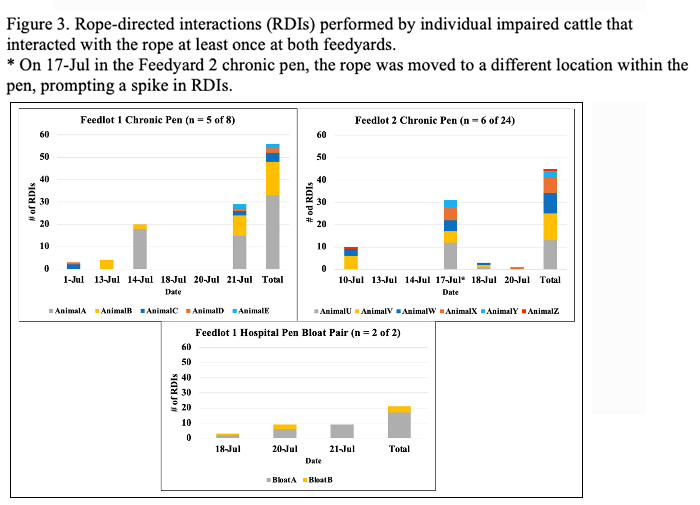
Focusing on the individual impaired cattle, only 29% of BRD cattle (6 of 21) performed at least one RDI, which is a lower rate than the chronically lame cattle. None of the acutely lame steers interacted with the rope, while 45% (5 of 11) of chronically lame steers did. Lameness is often a painful condition, and like sickness, pain can lead to decreased exploration and activity6. If the rope test can provide information about the current pain experience of individuals with different severity of acute or chronic lameness conditions, this would be a possible measure of negative welfare due to pain. Additional sampling of acutely and chronically lame cattle RDIs is needed to verify this hypothesis.
Bloat is also considered a painful condition7, so it is surprising that the bloat cattle in this study both performed RDIs on multiple days. Since these cattle had been recently treated and were anticipated to return to their home pens, high levels of RDIs may reflect progress towards recovery. In contrast, there were three mortalities in the F2 impaired pen. None of these heifers interacted with the rope during any test, and observers noted that they also showed no visual interest in the rope. These cattle were likely experiencing negative affective states such as pain, malaise, and breathlessness from their severe BRD, and unassisted death was a negative welfare outcome. Unassisted death may be more common in many chronic pens than euthanasia8. If the rope test can help earlier identify non-interested cattle, this may be useful as an additional indicator to help identify BRD cattle at risk of unassisted death to aid in timely euthanasia decision-making.
Implications and recommendations
When given the opportunity to interact with a simple cotton rope, impaired cattle in this study showed low levels of engagement, but with substantial individual variation. These individual differences may offer insight into how an individual animal is feeling at the time of observation and, more broadly, reflect aspects of their welfare state. Thus, the simple behavioral rope test shows promise as a tool for monitoring the welfare of impaired feedyard cattle.
Since management practices, facilities, and cattle characteristics vary across feedyards, implementing the rope behavioral test may require trial and error to identify the most effective logistics (e.g. location, timing, test duration) for your operation. Based on observations from this study, the following recommendations are given:
- Secure the rope using a zip tie or similar fastener, as some cattle interacted forcefully and were able to dislodge unsecured ropes.
- When hanging the rope, approach the pen slowly and calmly to minimize disturbance.
- During days with high ambient temperature, conduct observations before feeding to maximize interactions.
- Place ropes in high-traffic areas of the pen, but not close enough to the feed or water which may cause competing motivations.
- Changing the rope location after a few sessions in the same location may help renew impaired cattle interest.
References
- Tizard, I., 2008. Sickness behavior, its mechanisms and significance. Anim Health Res Rev 9, 87–99. https://doi.org/10.1017/S1466252308001448
- Cramer, M.C., Stanton, A.L., 2015. Associations between health status and the probability of approaching a novel object or stationary human in preweaned group-housed dairy calves. J Dairy Sci 98, 7298–7308. https://doi.org/10.3168/jds.2015-9534
- Gonyou, H.W., Stricklin, W.R., 1984. Diurnal behavior patterns of feedlot bulls during winter and spring in northern latitudes. J Anim Sci 58, 1075–1083. https://doi.org/10.2527/jas1984.5851075x
- Kilgour, R.J., 2012. In pursuit of “normal”: A review of the behaviour of cattle at pasture. Appl Anim Behav Sci. https://doi.org/10.1016/j.applanim.2011.12.002
- Stanford, K., Silasi, R., McAllister, T.A., Schwartzkopf-Genswein, K.S., 2009. Behavior of feedlot cattle affects voluntary oral and physical interactions with manila ropes. J Anim Sci 87, 296–303. https://doi.org/10.2527/jas.2008-1136
- Millman, S.T., Coetzee, J.F., 2021. Pain, in: Large Animal Internal Medicine. Elsevier, pp. 24–32.
- Phillips, C., 2002. The welfare of dairy cows, in: Cattle Behaviour and Welfare. Blackwell Science Ltd, Malden, MA, USA, pp. 10–22. https://doi.org/10.1002/9780470752418.ch14
- Sundman, E.R., Dewell, G.A., Dewell, R.D., Johnson, A.K., Thomson, D.U., Millman, S.T., 2024. The welfare of ill and injured feedlot cattle: a review of the literature and implications for managing feedlot hospital and chronic pens. Front Vet Sci 11, 1398116. https://doi.org/10.3389/fvets.2024.1398116
This monthly newsletter is free and provides timely information on topics that matter most to Iowa beef producers. You’re welcome to use information and articles from the newsletter - simply credit Iowa Beef Center.



