
Growing Beef Newsletter
January 2026, Volume 16, Issue 7
Progress Report: Characterizing grazing-tolerant alfalfa varieties in Southern Iowa
Erika Lundy-Woolfolk, Beth Reynolds, and Shelby Gruss
Alfalfa is a popular choice in beef cattle operations due to its high productivity and quality. Traditionally harvested as hay, alfalfa has been less favored for grazing because of bloat concerns and its limited persistence in pastures, where hoof traffic can damage the plant’s crown. However, with current economic pressures prompting cow-calf producers to extend the grazing season and reduce reliance on stored feeds, newer “grazing-friendly” alfalfa varieties have been developed. These varieties not only lower the risk of bloat but also feature improved root structures, such as creeping roots or sunken crowns, to better withstand hoof traffic. Limited trials in the Midwest have compared these varieties side by side over multiple years to assess changes in yield, quality, and stand persistence under grazing conditions.
An ISU study was designed to assess changes in yield, quality, and stand persistence of newer varieties of grazing-tolerant alfalfa that have been selected for reduced bloat risk and improved root structures to better withstand hoof traffic. Varieties of grazing-tolerant alfalfa utilized in the trial include:
- Creeping-root alfalfa – known for a creeping root or rhizomes, this variety is known for spreading across pastures to improve growth and persistence.
- Sunken crown alfalfa – compared to the traditional varieties, the plant’s crown grows below ground, offering increased tolerance to hoof traffic and better protection from winter damage.
- Falcata alfalfa – with a unique yellow bloom, this variety has a fibrous root structure, continues to grow after flowering, and is a winter-hardy, more drought-tolerant alfalfa option.
Alfalfa was planted at a seeding rate of 7 lb./acre, while the grass mixture was planted at 10 lb./acre to achieve a target stand composition of 40% alfalfa and 60% grass. One year after planting, the plots were grazed throughout the summer of 2025 as part of a rotational grazing system.
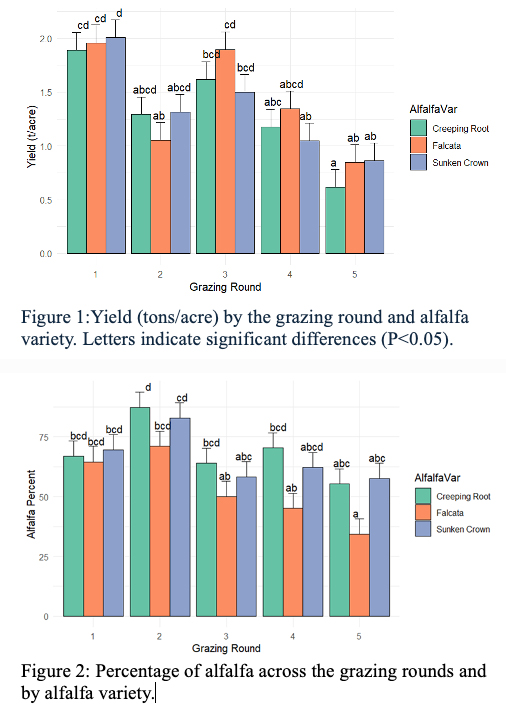
Due to uneven establishment, five locations within each plot were selected for persistence tracking. A multiple linear regression model was developed to assess the impact of alfalfa variety and grazing round on yield. The analysis revealed significant effects from grazing round. Round 1 (late May) had the highest yield at 2.05 tons per acre, while the subsequent three rounds averaged between 1.2 and 1.6 tons per acre (Figure 1). There was no yield improvement associated with alfalfa variety. A mixed-effects model was used to evaluate how alfalfa variety and grazing round influenced the percentage of alfalfa contributing to total yield. The model found significant effects from both grazing round and alfalfa variety, though their interaction was not significant (Figure 2).
Grazing round influenced alfalfa percentage, with Round 2 (early July) showing a significantly higher proportion of alfalfa in the stand at 80% (P < 0.05). The Falcata variety contributed 53% of the total yield, which was notably lower than Creeping Root (68%) and Sunken Crown (63%) (Figure 2). From the first grazing round to the last, Falcata was the only hybrid with a significantly lower percentage, but this may be more likely due to fall dormancy of 2 than to grazing pressure. To fully understand the effect of grazing on the alfalfa varieties, spring assessments are necessary. This will give us a greater understanding of the alfalfa persistence within the stand. Overall, alfalfa has persisted well throughout the first grazing season. The field site exhibited high heterogeneity, with large areas of poor germination. As four locations with adequate alfalfa stands were identified in each plot and monitored throughout the season. This likely contributed to the high alfalfa percentages observed than the initial 40% alfalfa and 60% grass stand targeted.
Note: This project is funded by Iowa State Beef Checkoff Program. This progress report shares results of the first of a two-year project.
This monthly newsletter is free and provides timely information on topics that matter most to Iowa beef producers. You’re welcome to use information and articles from the newsletter - simply credit Iowa Beef Center.



