
Growing Beef Newsletter
May 2026, Volume 16, Issue 11
Nitrogen fertilization decisions in pastures with high fertilizer prices
Aaron Saeugling, ISU Extension field agronomist and Rebecca Vittletoe, ISU Extension field agronomist
While spring is a common time to apply nitrogen fertilizer to pastures, seeing more than $900/ton of urea or over $600/ton of UAN may be leaving some producers reevaluating their nitrogen fertilization plans in pastures this growing season. To make the most out of our nitrogen applications with these higher prices, let’s get back to the basics.
What’s growing in my pasture?
Pasture species composition can impact our nitrogen decisions. Pastures that contain a mixture of grasses and legumes, such as alfalfa or red clover, may not require additional nitrogen. Legumes form a symbiotic relationship with soil bacteria that allows them to capture N from the air and “fix” that nitrogen into plant-available forms, supporting the legumes and even the grasses. Because of this, as a rule of thumb, if a pasture stand is composed of 30% or more legumes (on a DM basis), additional or supplemental nitrogen fertilizer is not needed. Maintaining a healthy legume population can be a very cost-effective strategy.
If tall fescue is a component of your pasture stand, avoid applying high rates of nitrogen, as this can increase the risk of fescue toxicosis. Incorporating legumes into these systems can reduce the need for nitrogen fertilizer while also diluting the effects of infected fescue in the diet. While tall fescue is very common in southern Iowa pastures, it can also be found in northern parts of the state.
Getting the most out of your nitrogen source
Common nitrogen fertilizer sources in pasture include urea, liquid 28 or 32% UAN (often applied with a herbicide) and ammonium sulfate. With these higher fertilizer prices, nitrogen losses are even more costly.
Surface-applied urea and the urea portion of UAN are susceptible to volatilization losses, especially with warm soil temperatures, high residue cover, moist soils, and little or no rainfall after application. Research shows that under warm soil temperatures, moist conditions, high residue cover, and no rainfall for 7 to10 days, N losses from surface applied urea can be as high as 20 to 30%. Losses from UAN are about half of those observed with urea because only the urea portion of UAN is subject to volatilization.
It doesn’t take much rain after an application to reduce losses. As little as 0.25 inches within one to two days after application can greatly minimize volatilization.
While we can try and time an application ahead of a rain event, Mother Nature doesn’t always cooperate. However, there are other ways that are within our control to minimize losses, which include:
- Using a urease inhibitor with urea or UAN, which slows the conversion of urea to ammonia gas and slows volatilization losses
- Applying a less volatile source of nitrogen like ammonium sulfate or ammonium thiosulfate
- Applying a combination of nitrogen sources
Selecting a nitrogen rate - focus on return
For nitrogen fertilization to be economically beneficial, the resulting yield increase should offset fertilizer and application costs while still providing a return, often by replacing purchased feed or extending grazing days.
Spring nitrogen application can be an effective tool for increasing early-season forage production, particularly in cool-season grass systems where growth and nitrogen demand are highest. Applied nitrogen is rapidly taken up in the spring, often resulting in strong yield and forage quality responses that benefit first-cut hay or early grazing.
However, in pasture systems, spring nitrogen can also create management challenges. Forage production during this period may exceed livestock demand, leading to wasted forage or reduced quality if it cannot be grazed or harvested in a timely manner. In many cases, spring growth already provides more forage than is needed. When excess production cannot be effectively utilized, delaying a portion of nitrogen application until late spring may be a better strategy. This approach can help extend forage availability later into the growing season and improve nitrogen use efficiency, particularly when fertilizer prices are high.
Therefore, it is important to focus on maximizing return with how much nitrogen is being applied. We typically get the most bang for our buck with the first 40-60 lbs of nitrogen/acre in terms of the amount of dry matter produced with each pound of nitrogen.
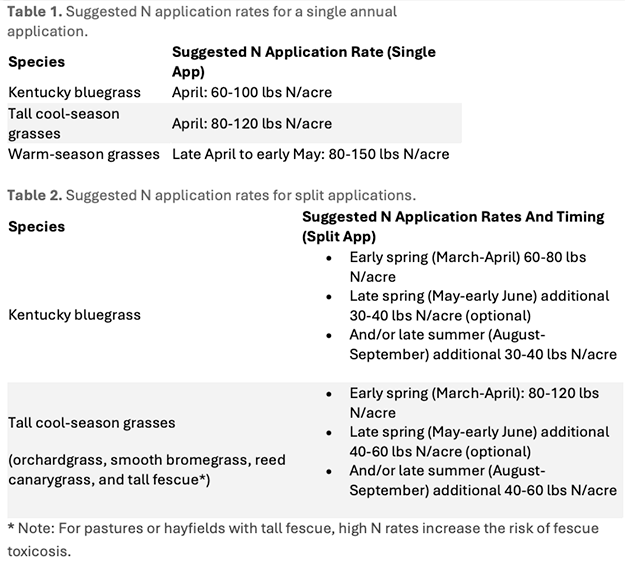
Tables 1 and 2 outline suggested nitrogen application rates for single or split nitrogen applications. These are guidelines, can be adjusted based on forage goals, management practices and stocking rate, nitrogen costs, and expected growing conditions.
With high nitrogen fertilizer prices, a closer look at pasture fertility plans can help protect the bottom line. Evaluating pasture species, selecting the right nitrogen source, applying it at the right time, and reducing losses can help ensure that every pound of nitrogen applied has the best chance to return value in added forage.
This monthly newsletter is free and provides timely information on topics that matter most to Iowa beef producers. You’re welcome to use information and articles from the newsletter - simply credit Iowa Beef Center.



