
Growing Beef Newsletter
September 2026, Volume 17, Issue 3
Extending the Grazing Season with Relay-Intercropped Cover Crops
Shelby Gruss, ISU Extension Forage Specialist and Lauren Jaschke, graduate student
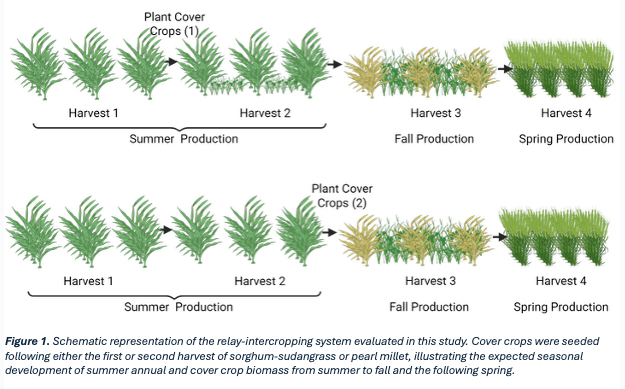
This study evaluated a forage management strategy that combines multi-cut summer annuals with cover crops to increase forage production from summer through the following spring. The project examines whether relay intercropping cover crops into standing summer annual forages can help livestock producers extend grazing opportunities and reduce stored feed needs.
Field trials were conducted in 2024 and 2025 at research farms near Boone and Nashua, Iowa. The study compared two summer annual forage species, sorghum-sudangrass and pearl millet, along with mixtures of cereal rye, oats (only in the 2025 field), and annual clovers planted after either the first August harvest or the second September harvest of the summer annuals. Researchers measured forage yield, cover crop establishment, light availability within the canopy, and forage quality.
Results showed a clear tradeoff between summer forage production and cover crop establishment. Sorghum-sudangrass consistently produced the greatest amount of summer forage, yielding between 3.4 and 7.2 tons of dry matter per acre across locations and years. Pearl millet produced less summer forage, ranging from about 2.3 to 3.4 tons per acre. However, pearl millet's more open canopy allowed more sunlight to reach the soil surface, creating better conditions for cover crop establishment. As a result, cover crops contributed a larger share of the fall forage in pearl millet systems than in sorghum-sudangrass systems. In 2025, cover crops accounted for roughly 55 to 60% of fall forage biomass following pearl millet compared with only 30 to 35% following sorghum-sudangrass. While there was limited fall cover crop growth in 2024, total fall mass being mainly contributed by the stockpiled summer annuals. Across years and locations, relay-intercropped systems produced an average of approximately 0.7 tons of fall forage dry matter per acre, with fall forage production ranging from 0.61 to 0.89 tons per acre depending on location, year, and summer annual species. While sorghum-sudangrass maximized summer forage yield, pearl millet supported greater cover crop establishment and increased the cover crop contribution to fall forage production.
Planting date was one of the most important factors affecting cover crop success. Cover crops seeded after the first harvest in early August consistently produced more fall growth than cover crops planted after the second harvest in September. At the Boone location in 2025, cover crop biomass from the early planting was more than three times greater than cover crops planted later in the season. Earlier planting also improved the likelihood of clover survival into the following spring.
Spring cover crop yields ranged from approximately 1.2 to 2.8 tons of dry matter per acre depending on location, and year. Summer annual did have a consistent effect on spring yields. Crimson clover showed particularly strong winter survival in Nashua during 2025, contributing nearly 34% of spring forage biomass when planted in early August. This clover also improved spring forage quality through higher crude protein concentrations.
From a practical standpoint, producers should choose summer annual species based on their forage needs. Sorghum-sudangrass is best suited for operations seeking maximum summer forage production. Pearl millet may be a better option when the goal is to establish productive cover crops that contribute additional forage in the fall and spring. Across all treatments, timely cover crop seeding was critical for success.
Overall, these early results suggest that relay intercropping cover crops into multi-cut summer annual forages can increase seasonal forage availability and potentially extend grazing opportunities. Success depends on balancing summer forage production with enough time, sunlight, and moisture to establish productive cover crops before winter. As weather variability continues to challenge forage systems across the Midwest, integrated approaches such as this may offer producers greater flexibility. Greater work needs to be done on cover crop and summer annuals species within this system.
This monthly newsletter is free and provides timely information on topics that matter most to Iowa beef producers. You’re welcome to use information and articles from the newsletter - simply credit Iowa Beef Center.



