
Growing Beef Newsletter
September 2026, Volume 17, Issue 3
High-Moisture Corn: Harvest and Feeding Considerations
Lauryn Smidt, ISU beef field specialist
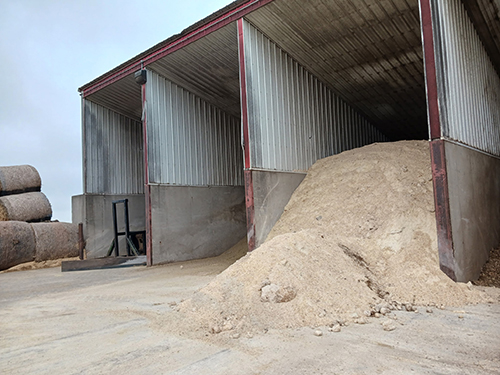 Cattle producers around the state may consider harvesting their corn earlier in the season as high-moisture corn, which is harvested around 28% to 32% moisture. There are many advantages of harvesting high-moisture corn, including no grain drying costs, increased yields, earlier harvest to avoid late season weather, and reduced pre-harvest field losses. Harvesting earlier can be especially beneficial when weather conditions later in the season could cause delays or increase the risk of field losses. However, there can also be disadvantages, such as the need for additional storage space, processing equipment, and the potential for corn to spoil if not stored correctly. Additionally, additives such as lactic acid bacteria inoculants may be used when the harvested corn has been frozen or is below the recommended moisture content.
High-moisture corn is processed by either rolling or grinding and is often stored in a bunker or bag. Proper storage is important because the corn must be tightly packed to ensure proper fermentation. Packing density should be 45 lb DM/cubic foot. Once the pile is properly packed, it needs to be covered immediately to limit oxygen exposure and reduce the risk of spoilage. Even with proper management, producers should expect approximately 5% shrink loss. Because high-moisture corn requires careful processing, packing, and storage, producers need to have the appropriate equipment and management practices in place before choosing this harvesting method. During feedout, 6-8 inches of the pile should be removed each day to help maintain a fresh pile.
With the added effort, why don’t producers just feed dry rolled corn?
High-moisture corn and dry rolled corn have very similar nutrient profiles when looking at protein and energy content. Dry rolled corn often has a larger particle size than high-moisture corn. High-moisture corn is processed by grinding it before being stored in a bunker. The smaller particle size and fermentation that occurs during storage increase the rate and extent of starch digestion in the rumen. Therefore, when feeding high-moisture corn, producers need to be aware that it has a greater rate of starch digestion, which can increase the risk of acidosis. Feeding high-moisture corn with wet distillers grains will help reduce the risk of acidosis. Additionally, mixing the ration well and using an ionophore will also help reduce the risk. Owens et al. (1997) summarized 521 research trials that compared dry rolled corn and high-moisture corn and found that diets with high-moisture corn had reduced dry matter intake by about 7.7%, while feed conversion improved by about 2%. However, research from Nebraska has shown that feeding a 50:50 blend of dry rolled and high-moisture corn improves efficiency by 4.6%. Overall, feeding a 50:50 blend of dry rolled corn and high-moisture corn may provide a good balance of performance and starch availability.
So, is high-moisture corn worth the extra management?
The answer depends on your operation. Producers should consider more than the potential feeding value when deciding how they want to harvest and store their corn. Storage capacity, processing equipment, labor, and the ability to properly ensile and manage the grain can affect the value of the high-moisture corn. If producers have the ability to feed high-moisture corn to their cattle, it can be a valuable feed option. If they do not have enough high-moisture corn to feed it exclusively, they could incorporate it into a 50:50 blend of dry rolled and high-moisture corn. Ultimately, the best harvest and storage strategy will depend on each operation.
Owens FN, Secrist DS, Hill J, Gill DR. The effect of grain source and grain processing on performance of feedlot cattle: a review, Journal of Animal Science. 1997. doi:10.2527/1997.753868.
This monthly newsletter is free and provides timely information on topics that matter most to Iowa beef producers. You’re welcome to use information and articles from the newsletter - simply credit Iowa Beef Center.



